|
|
HISTORICAL MINIATURES BY GEORGE GRASSE |
|
|
|
HISTORICAL MINIATURES BY GEORGE GRASSE |
|
AUSTRO-HUNGARIAN PHONIX D.I, 128.12, Oblt Roman Schmidt, Flik 30/J, Summer 1918
by George Grasse

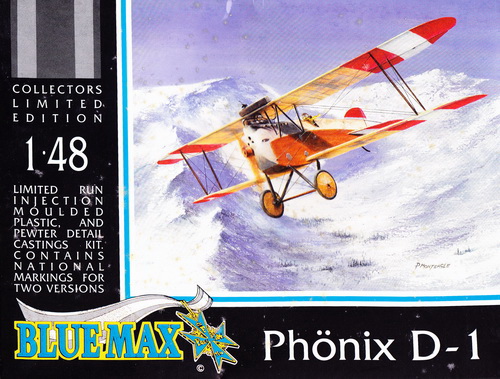
BLUE MAX 1/48th SCALE PLASTIC/METAL KIT #BX0116
| BLUE MAX BOX ART |
 |
| PHONIX D.I THREE-VIEW |
.jpg) |
|
This 3-view drawing is credited to Sigmund Tyrlik which appears
in Phonix D.I - D.II (see Bibliography below). The Phonix D.I
was produced in three versions as indicated by the serial number
which defines the engine and its manufacturer. There were two
sub-contractors to furnish 200hp engines: (Fi = Fiat) (Bd = Breitfeld, Danek) Phonix D.I 128.01 to 128.31 200hp Hiero Phonix D.I 228.01 to 228.55, 200 hp Hiero (Fi) Phonix D.I 328.01 to 328.34, 200 hp Hiero (Bd) Phonix D.I 128.12 is the subject of this build powered by the 200hp Hiero engine. The Phonix D fighters would evolve into D.II and D.III versions with airframe and engine differences. The Phonix 128 series was limited and assigned in small parcels to many of the Flik/D fighter units.This ea |
| THE MODEL TO BE BUILT |
%20x700.jpg) |
| This early Phonix D.I 128.12 was flown by Chefpilot Oblt Roman Schmidt of Flik 30/J, in the summer of 1918. Schmidt was a 6-victory ace and was confirmed with two victories on 128.12, an Italian SAML (12 July 1918) and a Bristol F2b (23 July 1918). The camouflage scheme depicted above is interpreted as chiefly brown dabs over all top surfaces and fuselage sides. Undersides were CDL except for the fuselage which is assumed to be natural varnished plywood. |
| Chefpilot Oblt Roman Schmidt |
%20Schmidt%20Photo.jpg) |
| CONSTRUCTION PHOTO Nos.1a & 1b |
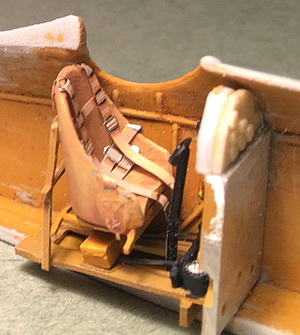 |
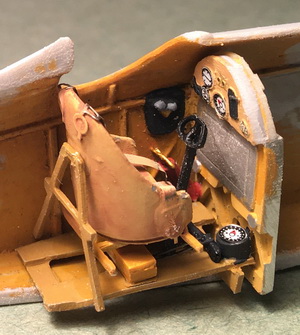
| The beginning always starts with the cockpit interior most of which is already built up. In the left photo can be seen the floor mounted compass (Eduard PE instrument). Safety belts are from Eduard's French WW2 bomber PE sheet. The instrument panel is made up of Eduard dials drom their instruments PE sheet. |
| CONSTRUCTION PHOTO No.2 |
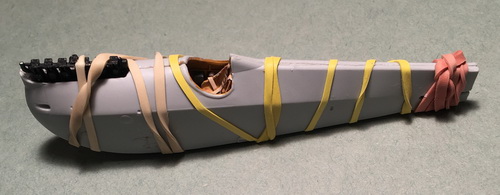 |
| Not a terribly interesting photo but I nearly glued the halves and nearly forgot the engine! |
| CONSTRUCTION PHOTO No.3 |
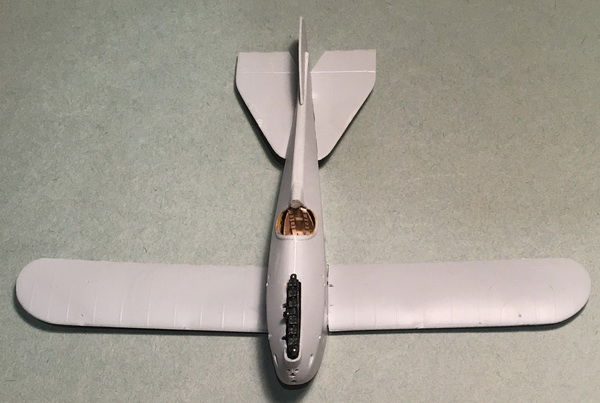 |
| Both lower wing halves were pre-drilled for brass pins. Corresponding holes were drilled into the lower fuselage sides (clearly marked). Super glue and plastic glue was used to cement the lower wing halves to the fuselage. Next, the tail assembly was glued in place. |
| CONSTRUCTION PHOTO No.4 |
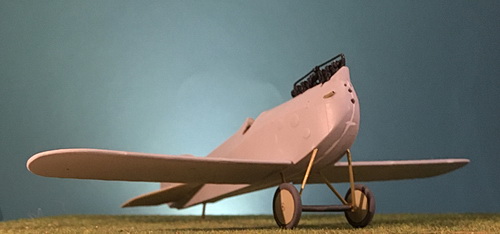 |
| The landing geasr was made from brass tube, brass rod, and lead sheet for the aerfoil. The ends of the kit's struts had and hole for the axle. I used fine electrical copper wire and super glue to secure a good bond. |
| CONSTRUCTION PHOTO No.5 |
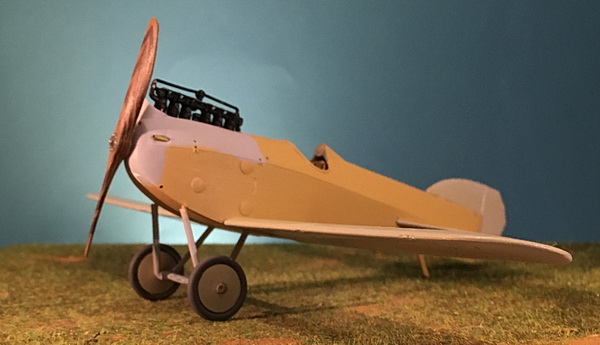 |
| It's time to work on painting of the top surfaces and the fuselage. The pale gray primer on the front of the fuselage is reserved for an aluminum finish. When that's done, the relatively fine brown splotching will be applied including the upper surgace of the top wing. The underside of the of the flying surfaces is painted using (of all things) a very old bottle of Misterkit MKAH01 Austro-Hungarian Clear Doped Linen (CDL). In this photo, the CDL color is shown. |
| CONSTRUCTION PHOTO No.6 |
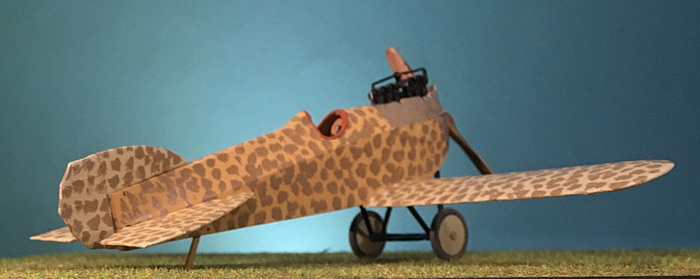 |
| This is the first application of the brown camouflage scheme originally adoped at the Phonix factory. Later Phonic D series fighters were shipped in a green "forest" motif. I used an ancient bottle of Misterkit MKAH04 Phonix Medium Brown. Many, Many years ago when I discovered the excellent Misterkit line, I had storage problems with their paints which came in a plastic bottle. These dried up rather quickly so I changed over to Testor's glass bottles and preservation is excellent. I never seem to throw away a paint brush and one of them was retrieved to do the dappling of the medium brown. I'm going to try a earth tone wash oiver the dappling but on scrap wings. |
| CONSTRUCTION PHOTO No.7 |
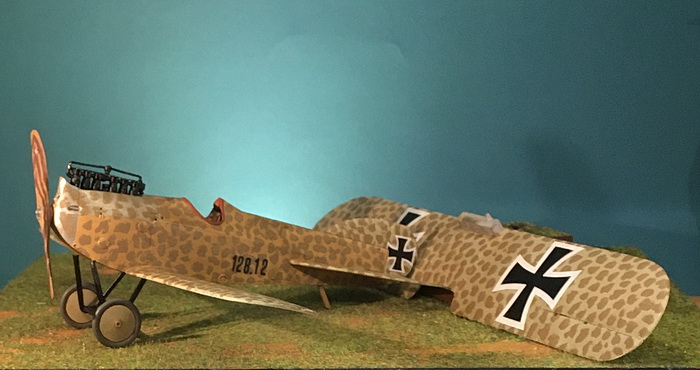 |
| I oversprayed the model with Vallejo Acrylic Saton Varnish to apply decals. Only the topside had decals supplied at this time. I did apply a wash of Vallejo Model Wash - European Dust but did not achieve the effect I wanted. One more step is required to get a proper camouflage effect. |
| CONSTRUCTION PHOTO No.8 |
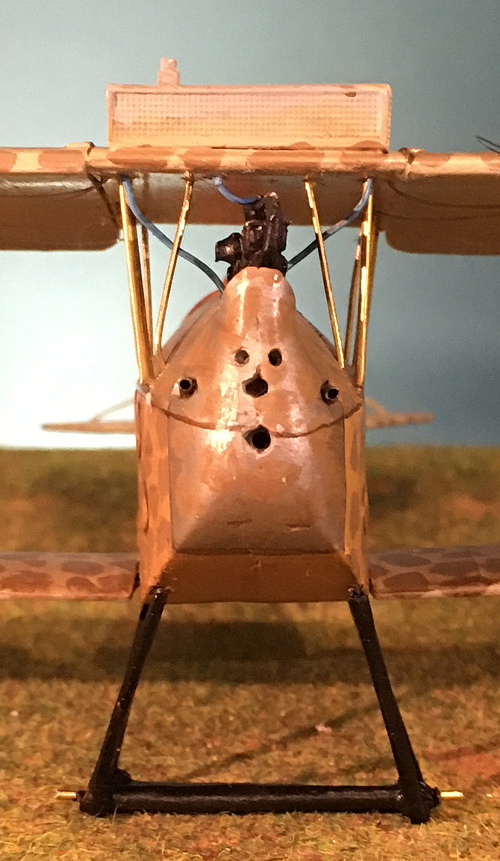 |
| Top wing attachment starts with the four main fuselage struts. The Phonix D.I has a rather high number of vertical supports: four fuselage struts, two narrow angled support struts at front, two aileron control rods at the rear fuselage struts, and three water lines to/from radiator/engine. |
| CONSTRUCTION PHOTO No.9 |
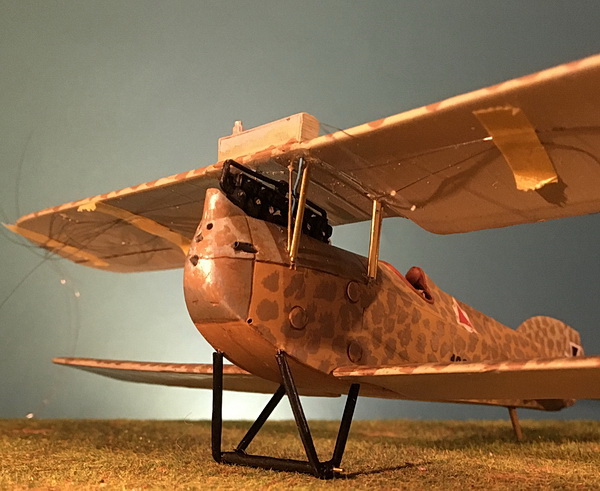 |
| This angled view shows some of the fuselage main struts, the thinner support struts and one of the water lines between the two at front. At rear, the right aileron control rod is barely behind the strut. |
| CONSTRUCTION PHOTO No.10 |
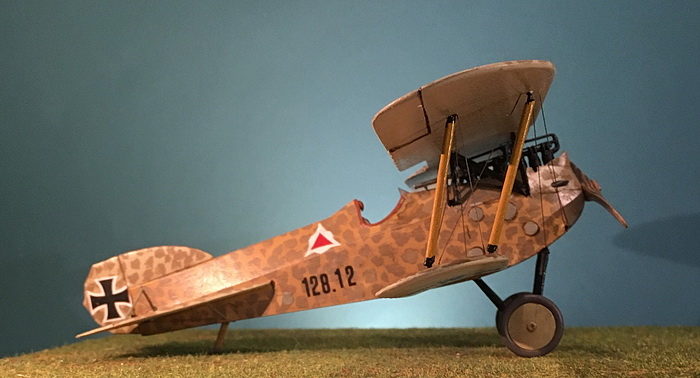 |
| The model is finished. The top wing has been secured with the addition of the outer wing struts and complete rigging using .006 MFT. Extensive work was done to the area around the engine and included the addition of six exhaust stubs on the port side (see next photo), a clear plastic windscreen, and a tubular gunsight made from 1.0mm brass tube with brass rod supports. One additional round access door was taken from another kit and added to the right rear fuselage just below the front of the horizontal stabilizer (it was not molded onto the fuselage but appears in drawings and photos). Additional work is described in the following photos. |
| CONSTRUCTION PHOTO No.11 |
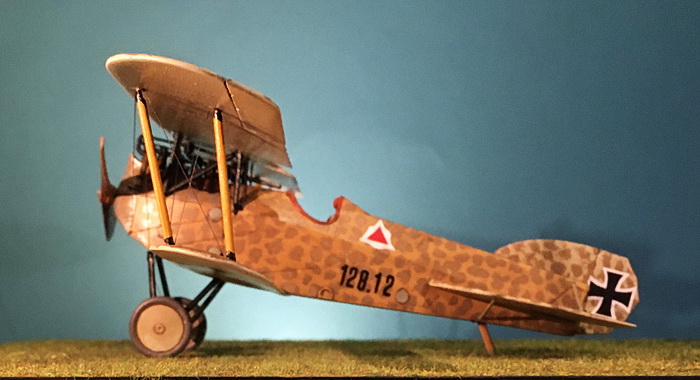 |
| It is difficult to see the array of exhaust stubs in this photo. A pair of horizontal stabilizer struts were made from old Strutz rod and appear just above the tailskid. The pilot's personal insignia copied from the JaPo book Phonix D.I - D.II, re-sized up and printed on laser decal paper. Two appear on either side of the fuselage as shown and one more appears on the underside. All three were completely retouched with acrylic paint. The serial number 128.13 was taken from Blue Rider's decal sheet BR509, Flugzeugnummern, World War I Austro-Hungarian Serials. |
| CONSTRUCTION PHOTO No.12 |
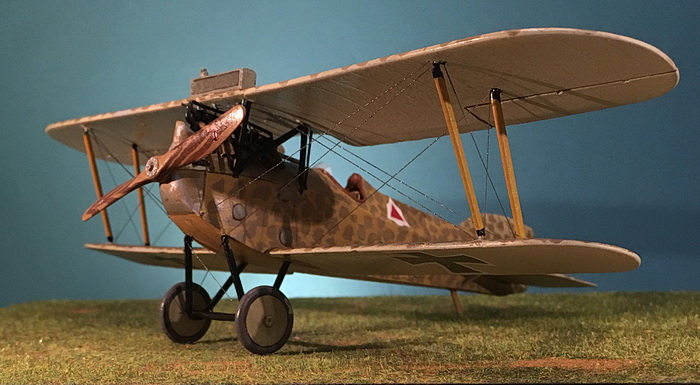 |
| Iron cross decals are from a variety of stashed 1:48 scale German aircraft decals. The kit's decals were not viable. If nhot already mentioned, propeller decals are from IF Models set C4860, Austro-Hungarian Producer's Propeller Labels. |
| CONSTRUCTION PHOTO No.13 |
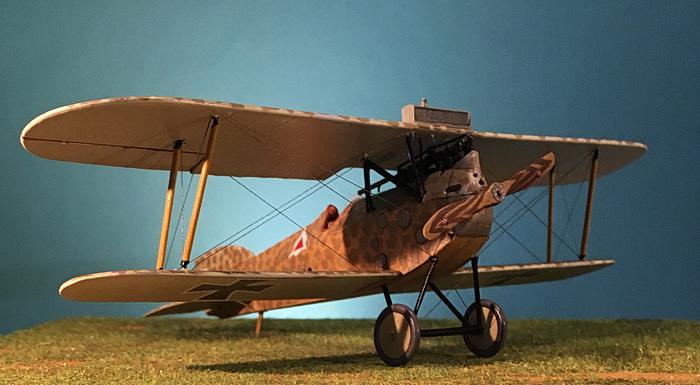 |
| This view shows telescopic gunsight to good effect. Hand-painted propeller detail and small Austrian propeller manufacturer decals are nicely shown. |
| CONSTRUCTION PHOTO No.14 |
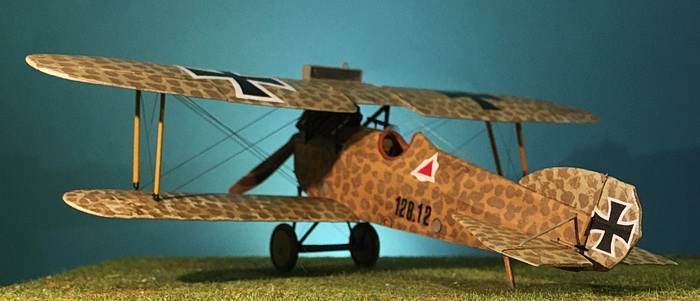 |
| This left rear view shows the correction of the top right wing's iron cross from a white outline to plain black cross. I've not seen the explanation for this but my guess is a recognition feature. Why? The most preferred angle of attack is against an opponent from above and to the rear. Why? A high angle descent increases speed and takes advantage of the opponent's difficulty of checking that position, high left, high right, or high dead center. The presence of an unorthodox all-black cross goes to prevent friendly attacks. |
| CONSTRUCTION PHOTO No.15 |
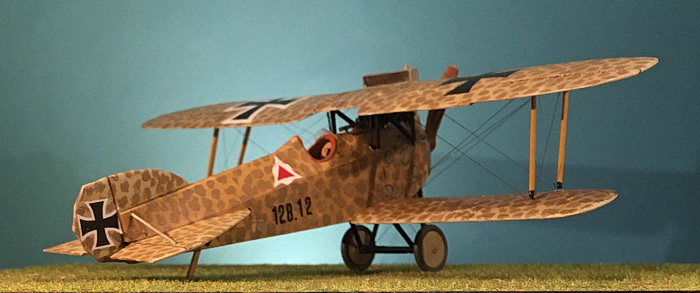 |
| The right side rear view also highlights the all-black right upper wing iron cross. Note that the fuselage struts, aileron push rods, are all painted in black. |
| CONSTRUCTION PHOTO No.16 |
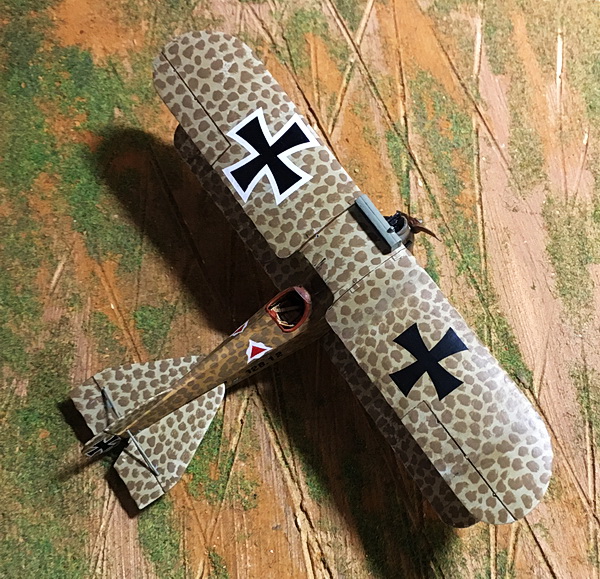 |
| The "speckled" camouflage in brown was intended to "hide" the aircraft from above over fall-winter brown terrain. This camouflage was applied at the Phonix factory on D.I fighters. When the Phonix D.II appeared, it was similarly covered in the same pattern but in forest green. |
---------------------------- .... finis.... -------------------------------
References:
Chant, Christopher. Austro-Hungarian Aces of WW1, Osprey Aces No.46. Oxford, UK: Osprey Publishing, 2001.
Cowin, Hugh W. German and Austrian Aviation of World War I. Oxford, UK: Osprey Publishing, 2000.
Grosz, Peter. Phonix D.I-D.II, Windsock Datafile 31. Berkhamsted, UK: Albatros Productions Ltd, 2000.
Grosz, Peter M, George Haddow, and Peter Schiemer. Austro-Hungarian Army Aircraft of World War One, scale drawings by George Haddow. Boulder, CO: Flying Machines Press, 2002.
Tesar, Aharon Petr. K.u.k. Luftfahrtruppe Photo Album 1914-18, Volume 1. Ostrava-Poruba, Czech Republic: Revi Publications, 2008.
Zahalka, Jan, Mgr. Petr Aharon Tesar and Sigmund Tyrlik. Phonix D.I - D.III. Prague: JaPo Publishing, 2005.
GO TO?
15 February 2026
