|
|
HISTORICAL MINIATURES BY GEORGE GRASSE |
|
|
|
HISTORICAL MINIATURES BY GEORGE GRASSE |
|
|
SPAD 13, S.2430, Sergeant Frank Baylies, Escadrille Spa.3, 1918 |
by George Grasse
EDUARD 1:48 SCALE PLASTIC INJECTION MOLDED KIT EU8196 OF THE SPAD 13
|
EDUARD
EU8196 BOX ART
|
%20Box%20Art%20x500.jpg) |
| SPAD 13 3-VIEW DRAWING |
%20Three-View.jpg) |
| This 3-view drawing is credited to J. D. Carrick or F. Yeoman and appeared in Fighter Aircraft of the 1914-1918 War compiled by W. M. Lamberton and published by Harleyford Publications Limited. The French-designed Spad 13 was the improved version of the Spad 7 fighter. |
|
THE
MODEL TO BE BUILT - An Incorrect Profile
|
%20Build.jpg) |
| The model to be built represents Spad 13 S.2430 red '21' flown by American volunteer pilot Sergeant Frank Baylies (4 victories on this aircraft, 12 victories overall) of French Escadrille Spa.3. This profile was created by David Mechin and taken from his monumental work, The WW1 French Aces Encyclopedia, Volume 1, published by Aeronaut. However, it is depicted as a late Spad 13 but is more properly named as an early Bleriot Spad 13 with early 'wing pockets' to improve manuverability (see below). |
|
THE
MODEL TO BE BUILT - The Correct Profile
|
.jpg) |
|
The correct left-side profile was produced by
Alexandr Kasakov in the 3-part series
The Spad X.III
(Spa 13 C.1) Volume 1: Early Version by
Martin Schutz published by Aeronaut. The
model to be built remains Spad
13 S.2430 red '21' flown by American volunteer pilot
Sergeant Frank Baylies. However, it is more properly
identified as an early Spad 13 built by Bleriot and
featured several distinguishing characteristics: 1) the fuel filler cap is on the port side faintly seen between the struts. 2) the cowling is of the two-piece style. 3) spent shell casing chutes not present above lower wing. 4) A single spent cartridge chute is adjacent to the left rear cabane strut. 5) this profile shows the early Bleriot camouflage style. 6) the wing tips are corrected with "wing pockets" in gray. 7) the drag wire from the top of the front cabane strut is uncovered. 8) the windshield is slightly of a "wrap-around" style. |
|
THE
MODEL TO BE BUILT - The Top View
|
.jpg) |
| The correct representation of S.2430 in top view shows the gray-colored "wing pockets" and the correct Bleriot camouflage. |
|
CONSTRUCTION PHOTO No. 1
|
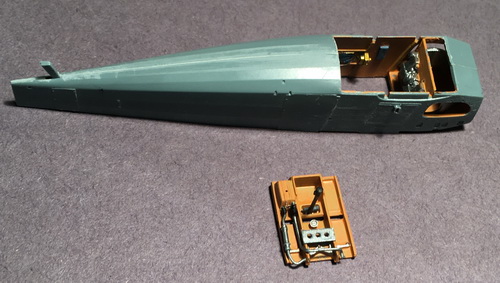 |
| Cockpit interior parts are shown above. Each fuselage half was prepared according to the kit's instruction manual. The forward 'firewall' was completed and it and the two halves were glued together as shown. The cockpit 'floor' is completed ready for installation. |
|
CONSTRUCTION PHOTO No.
2
|
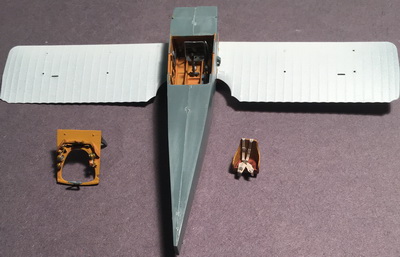 |
| Additional cockpit interior parts are ready to be installed. The lower wing has been primed and is glued in place. |
|
CONSTRUCTION PHOTO No.
3
|
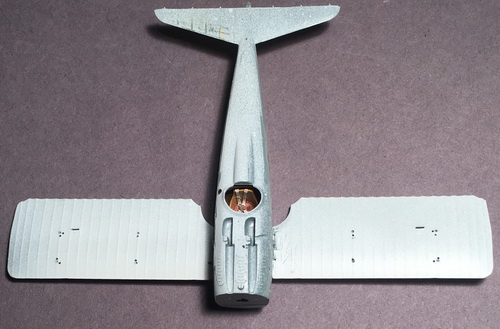 |
| The seat was installed first followed by the instrument "shelf". After several trial fittings, the fuselage top was glued in place. Additional cockpit interior parts are ready to be installed. The lower wing has been primed and is glued in place. |
|
CONSTRUCTION PHOTO No.
4
|
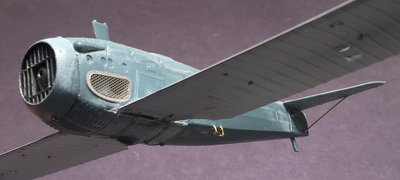 |
| This view shows additional progress of metal parts. The PE side engine covers replaced the plastic kit parts. A foot step was made from brass rod to replace the kit's plastic part. At the tail, brass rods support the horizontal stabilizer in place of the kit's plastic parts. |
|
CONSTRUCTION PHOTO No.
5
|
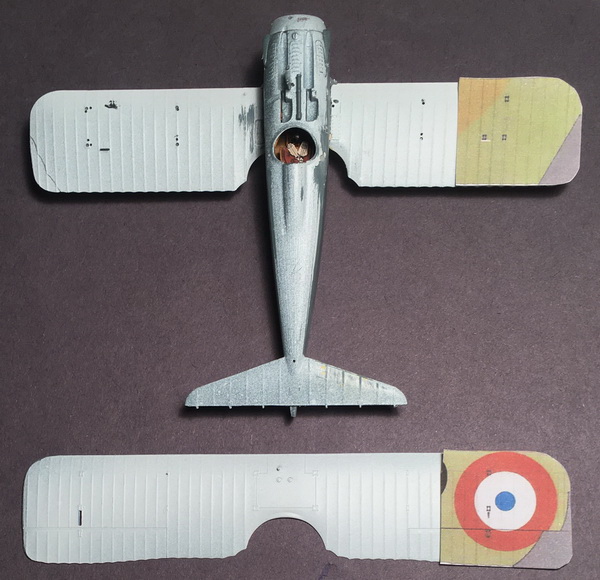 |
| To comply with the correct wing set which featured plywood "wing pockets", I reproduced the profiles by Alexander Kasakov in The Spad X.III (Spa.13 C.1) Volume 1: Early Version, page 205. The wing tips for upper and lower wing were cut out as shown above and used as models from which the trimming of the wing was accomplished to the correct "square-ended" configuration. The wing pockets were painted in gray. |
|
CONSTRUCTION PHOTO No.
6
|
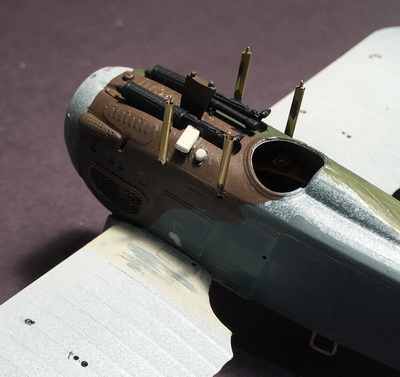 |
| Now, I'm preparing the forward fuselage for top wing placement. Modifications to the kit are shown here in the form of two white plastic replacements. On the left is the spent cartridge ejection chute and to the right is the fuel filler cap. Below these is the putty filling of the kit's ejection chute applicable to late Spads only, this being an early Bleriot Spad. Also shown are the replacement fuselage struts of brass tube and rod, the center water housing and two Vickers machine guns. Each front strut had the additional attachment of a heavy gauge steel drag wire not shown. In late versions, this wire was housed and is present in this kit which I removed. |
|
CONSTRUCTION PHOTO No. 7
|
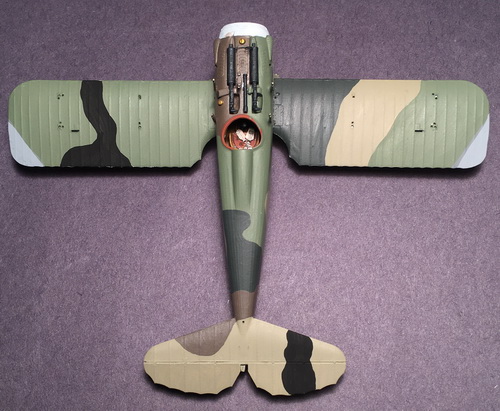 |
| The second coat of the camouflage except for the top wing shows the pattern for the early Bleriot-built Spad 13. The plywood wing extentiions are clearly shown. My long-standing 1918 French light green has been significantly lightened to come close to the original. |
|
CONSTRUCTION PHOTO No. 8
|
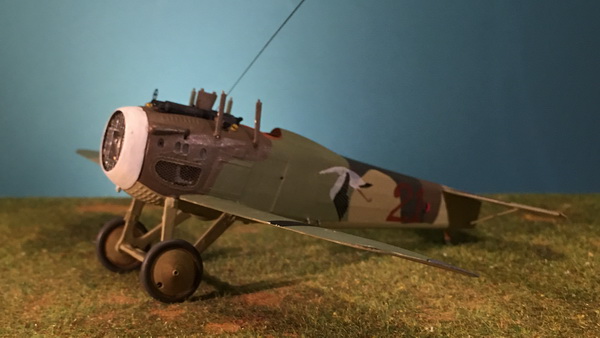 |
| The upper surface of the fuselage and flying surfaces are painted in the 5-color scheme of 1918 and decals have been applied to the aft fuselage. The upper wing (not shown) has been rigged and readied for attachment. The undersurfaces if the fuselage and wings have been painted in my mix of Vallejo CDL or "ecru" as some sources call it. As a general rule, CDL undersides were standard to Bleriot, Kellner. Blanc bleute (or pale gray) was unique to Levasseur, SCAF, Spad, and Bernard. |
|
CONSTRUCTION PHOTO No.
9
|
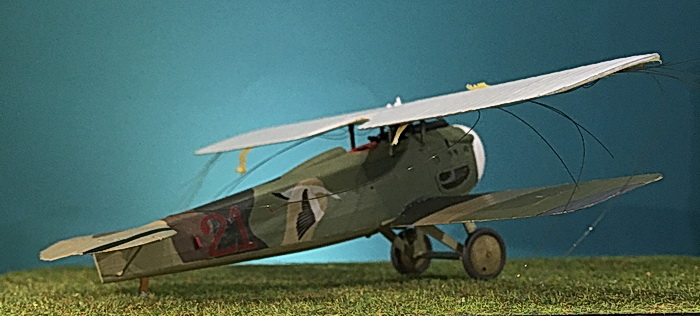 |
| Before attaching the top wing, all of the rigging wires were individually glued to the underside of the top wing. These were taped away from the fuselage strut holes. The top wing was then glued to the metal fuselage struts and carefully aligned. |
|
CONSTRUCTION PHOTO No.
10
|
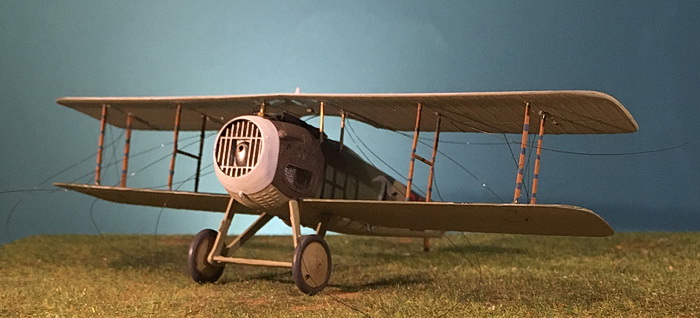 |
| All struts are installed. The outer wing struts are the only ones rigged so far. |
|
CONSTRUCTION PHOTO No.
11
|
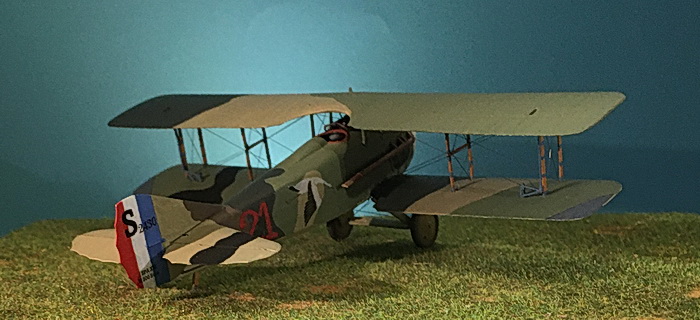 |
| Rigging is complete except for the rudder wires. The model has the top wing painted in two coats and then oversprayed in Vallejo Acrylic Satin Varnish, ready for final decal application. The wingtip extensions to the top wing have not yet been painted and will look similar to the bottom wing. |
|
FINISHED PHOTO No. 12
|
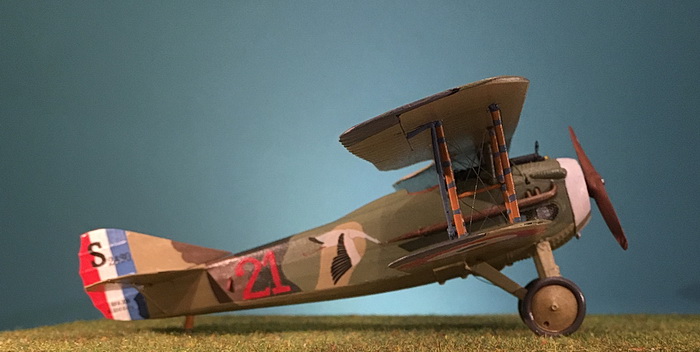 |
| The tail unit was pre-painted and had decals applied; then. glued to the fuselage. |
|
FINISHED PHOTO No. 13
|
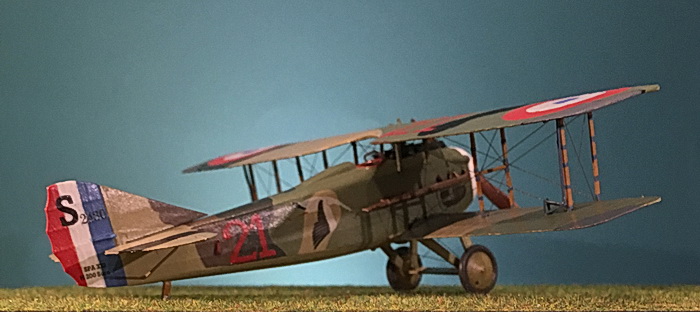 |
| Wing roundel decals were next applied. The black "foot print" on the top wing was painted in place. Next, the red "21" decal was added so as to barely touch the "foot print". |
|
CONSTRUCTION PHOTO No. 14
|
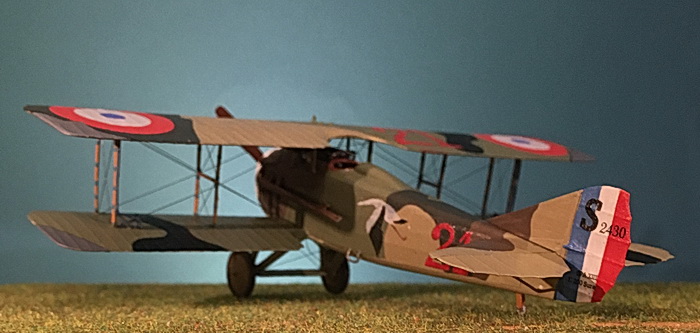 |
| Decals: I used Peddinghaus decal set EP 48 4367, French Spad S.XIII Aces, Early Bleriot-built for Frank Baylies aircraft S.2430. But, there are exceptions because the color intensity of the decals is weak due to fine thickness. In other words, and especially for the color 'white', the underlying shade is weak. For this reason, I used Eduard roundels which have no transparency and the colors are truer. The red "21" had to be re-painted in Vallejo 957 Red. The "stork" insignia had to be highlighted on its white portions. The rudder stripes were hand-painted and the decals were made by me. Overall, the Peddinghaus decals were a disappointment. |
|
CONSTRUCTION PHOTO No. 15
|
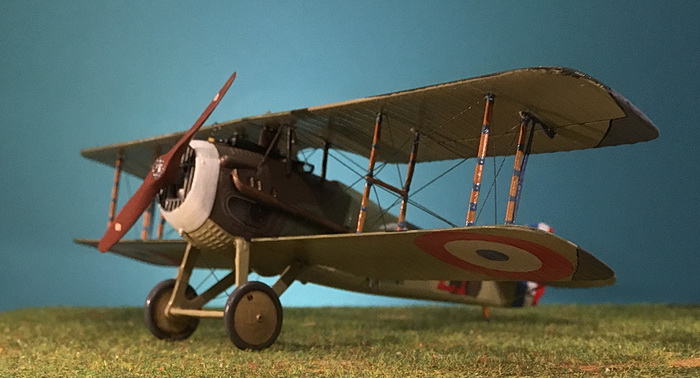 |
| This photo shows the medium gray wingtips representing the "squaring" of the otherwise rounded tips of the wing which inhibited manuevering. This modification was incorporated into all Spad 13s built up to that point. Current production aircraft now included a revised wing set. |
|
CONSTRUCTION PHOTO No. 16
|
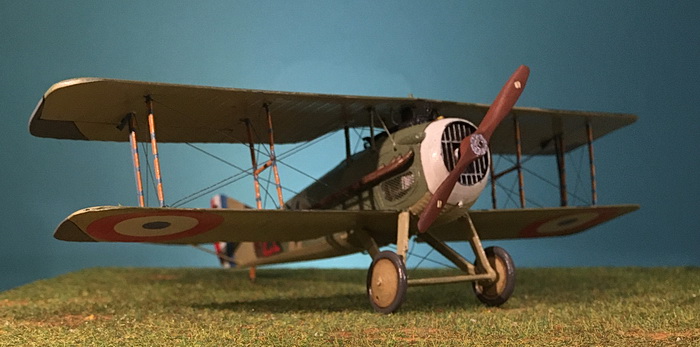 |
| The propeller logo was my creation (I don't have references to French propeller manufactures and their logos. The wire strengthening strut just in front of the forward cabane strut was not originally encased in wood as the other struts. In later production, it was covered. |
|
CONSTRUCTION PHOTO No. 17
|
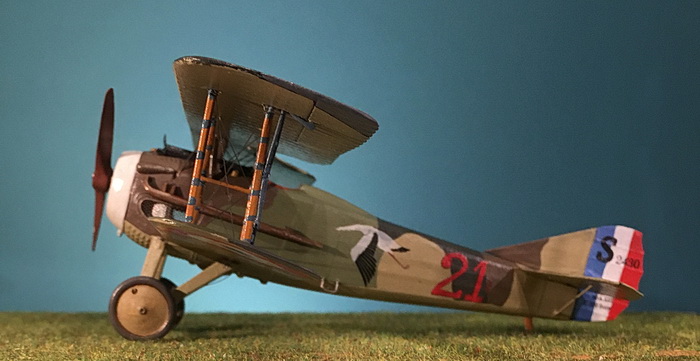 |
| This view shows a construction error in the outside rear strut. The aileron control rod is bent, something I did not catch. I also did not catch the wing's leading edge paint inconsistencies. |
|
CONSTRUCTION PHOTO No. 18
|
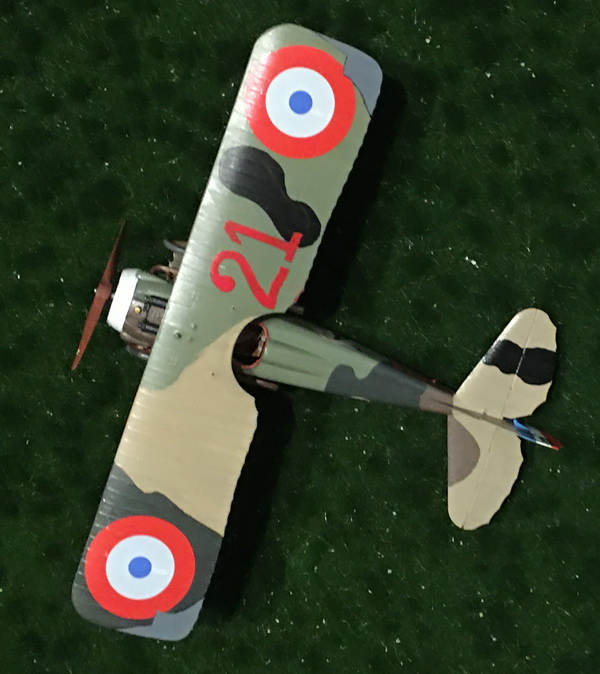 |
| The overall 5-color camouflage scheme is based on good sources especially Martin Schutz's The Spad S.XIII, Volume 2, Mid/Late Version. The Peddinghaus diagrams that are part of their decal set are nearly identical. Note the wingtip plywood extensions that brought the wingtips to a "square-ended" configuration. |
%20photo.jpg)
Bibliography:
Andrews, C. F. The SPAD XIII C.1. Leatherhead, Surrey, UK: Profile Publications.
Bruce, J. M. SPAD 13.C1 Windsock Datafile 32. Berkhamsted, Herts: Albatros Productions, 2000.
Bruce, J. M. SPAD Scouts SVII - SVIII. United States: Glencoe Models.
Conners, John F. SPAD Fighters in Action. Carrollton, TX: Squadron/Signal Publications, 1989.
Lamberton, W. M., Compiler, and E. F. Cheesman, Editor. Fighter Aircraft of the 1914-1918 War. Los Angeles, CA: Aero Publishers, 1962.
Mechin, David. The WW1 French Aces Encyclopedia (8 volumes). Aeronaut Books, 2021.
Schutz, Martin. The Spad S.XIII, Volume 2, Mid/Late Version. Aeronaut Books, 2024.
Toelle, Alan D. "French 1918 Camouflage Colors - Typical Palette", 2001.
GO TO?
8 October 2025
