|
|
HISTORICAL MINIATURES BY GEORGE GRASSE WORLD WAR 1 AIRCRAFT IN 1:48 SCALE |
|
|
|
HISTORICAL MINIATURES BY GEORGE GRASSE WORLD WAR 1 AIRCRAFT IN 1:48 SCALE |
|
| FRIEDRICHSHAFEN FF.33L, MN.1174, SFS WINDAU, 1917 |
by George Grasse

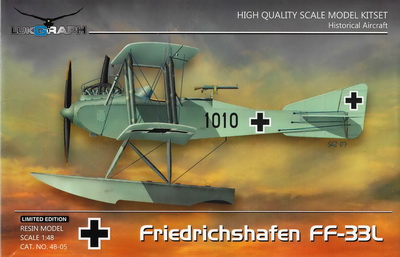
LUKGRAPH 1:48 SCALE INJECTION MOLDED KIT LG4805 of the FF.33L
|
LUKGRAPH LG4805 BOX ART
|
 |
|
FRIEDRICHSHAFEN FF.33L
THREE-VIEW DRAWING
|
.jpg) |
| This 3-view drawing is taken from Gray & Thetfords's book German Aircraft of the First World War, page 122. It shows an abbreviated layout of the FF.33L type and its two-bay biplane layout. |
|
FRIEDRICHSHAFEN FF.33L
THREE-VIEW DRAWING with TECHNICAL DATA
|
%20x500.jpg) |
| This 3-view drawing is credited to the Seeflugzeug Versuchs Kommando which produced an extensive work of detailed drawings for all of the German Navy's sea-borne aircraft of World War 1. In this case. the drawing is specific to a set of serial numbers appearing on the left side midway down. The model to be built MN.1174 and does not appear on this drawing but the general layout is comparable. |
| THE FF.33L TO BE BUILT |
.jpg) |
| The model to be built is the Friedrichshafen FF.33L, Marine Number (MN) 1174, flown by Flugmaat Gruber (P) and Ltn z See Eisenlohr, based from Seeflug Station Windau on the Baltic. The type L was one of several iterations of the FF.33 series. The original FF.33 aircraft starting with letters A, B, and C, for example, were three-bay, long-range two-seat reconnaissance aircraft with no expectation of meeting armed enemy aircraft and were themselves unarmed. As the war quickly progressed, arming floatplanes became necessary. To the extent that these aircraft were still vulnerable, slightly smaller two-bay versions were developed to escort reconnaissance and bombing floatplanes. The FF.33L was developed under these requirements and along with single-seat naval floatplanes such as the Albatross W.4 and Rumpler 6.B series, provided enhanced protection. In the scheme of German naval aircraft, this FF.33L is classifed as C2MG meaning that it is a C-Type armed with two machine guns, one fixed for the pilot and one flexible for the observer. Most FF.33L aircraft were built as HFT meaning they were configured to carry combing equipment and a wireless transmitter and receiver. Only the observer was armed with a flexible ring-mounted machine gun. Note that this aircraft is camouflaged in the late-war three-color hexagonal scheme. |
| PHOTO OF THE MODEL TO BE BUILT |
.jpg) |
| This photo is taken from Seaplane Station Windau 1916-1918 by Michael and published by Aeronaut Books. FF.33L MN.1174 is sitting on its dolly and being pushed to the end of the dock which gradually flows downward into the sea for takeoff and landings. |

| The Crew of FF.33E MN.1174 | |
%20180.jpg) |
%20180.jpg) |
| Pilot: Flugmaat Gruber | Observer: Ltn z See Eisenlohr |
| CONSTRUCTION PHOTO #1 |
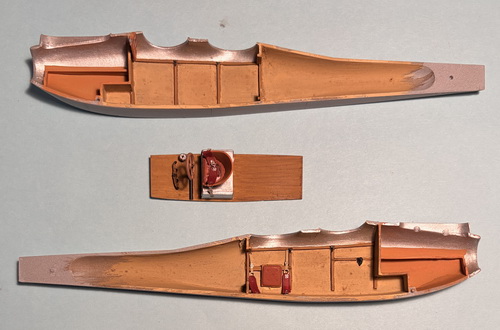 |
| The beginning always starts with the fuselage interior. The Lukgraph kit has sparse cockpit interior details which are shown above. Being a C2MG version, it was not equipped with a wireless, bomb racks, or photograpic equipment. It was strictly an escort version to those equipped for special purposes. However, I will add more details. |
| CONSTRUCTION PHOTO #2 |
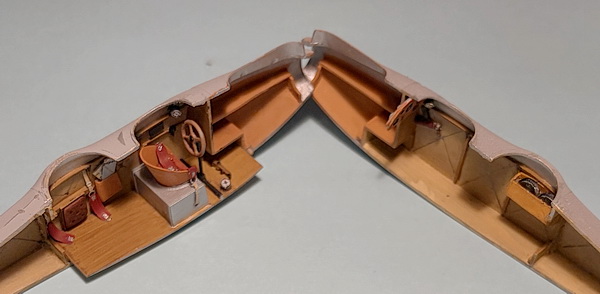 |
| Cockpit detailing is completed. Scratch-built additions include the ammunition box on the right with two Aeroclub Parabellum magazines, open map case on the left adjacent to the rear cockpit seat, compass adjacent to the pilot's seat in the floor, pressure pump on the right side of the front cockpit, and several additional gauges, upper left and right corners. Seatbelts are Eduard. Engine is next. |
| CONSTRUCTION PHOTO #3 |
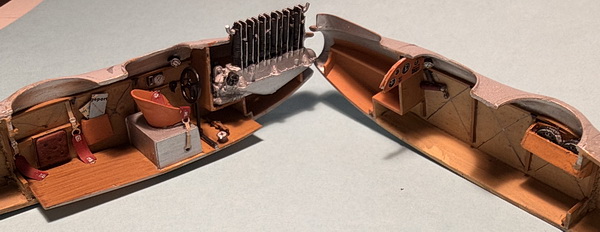 |
| Final cockpit detailing: engine is installed. One scratch-built addition is a small instrument panel left of the pilot's seat. The steering wheel has been re-painted semi-gloss black. |
| CONSTRUCTION PHOTO #4 |
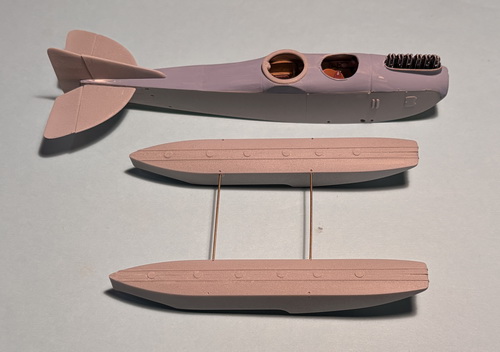 |
| Fusleage halves are super glued together with a fair amount of plastic putty, extensive sanding, priming, and a coat of paint. The tail unit started with brass pins inserted into the horizontal stabilizers and super glued. I used brass pins instead of the parts small stubs. The rest of the tail unit was straight forward using super glue only since their profile was too thin for brass pins. The floats were prepared as shown using brass pins leaving a 40mm gap as directed in the instructions. |
| CONSTRUCTION PHOTO #5 |
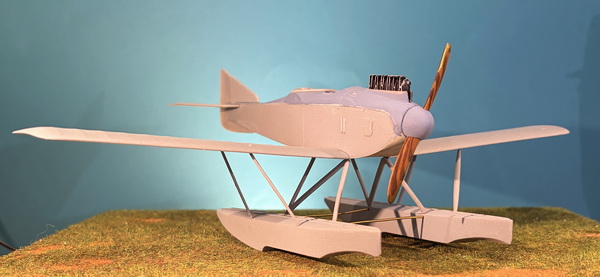 |
| The first step here, is attachment of the lower wings which were augmented with an additional brass pin other than the one supplied already attached to each wing. Plenty of super glue was used here. When the glue was set up, I started on the float struts. The first two added were the inner "N" struts already pinned. The ends of pins attached to the fuselage or the floats were not altered but I had to be sure that the holes were drilled deep enough. The fit was perfect. Each strut was then raised slightly at all points to allow for a generous but not overflow of super glue. The outboard struts were slightly modified in having the ends to be attached to the underside of the lower wing cut short so as not to protrude through the wing. |
Bibliography:
Gray, Peter and Owen Thetford. German Aircraft of the First World War. London: Putnam & Company Limited, 1962.
Grosz, P. M. FF.33E - Windsock Datafile No.73. Berkhamsted, UK: Albatros Productions Ltd, 1999.
Herris, Jack. Friedrichshafen Aircraft of WWI. Aeronaut Books, 2016. ISBN: 9781935881353.
Schmeelke, Michael. Seaplane Station Windau 1916-1918. Aeronaut Books, 2025. ISBN: 9781964637297.
GO TO?
10 September 2026