HISTORICAL MINIATURES BY GEORGE GRASSE
WORLD WAR 1 AIRCRAFT IN 1:48 SCALE

NIEUPORT 11 Nr.1232, RUSSIAN 7th FIGHTER DETACHMENT, 1917

by George Grasse

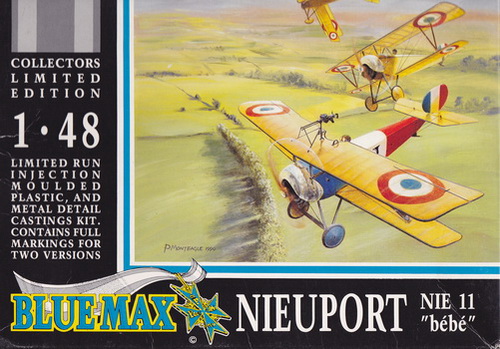
BLUE MAX 1:48 SCALE INJECTION KIT BX0103 of the NIEUPORT 11 in RUSSIAN SERVICE

BLUE MAX BX0103 BOX ART


NIEUPORT 11 3-VIEW DRAWING
This 3-view drawing is reproduced here from the Harleyford publication Fighter Aircraft of World War 1.  The Nieuport 11 was an early export to Russia and assigned sparingly to its Fighter Detachments until Russian production could begin to produce aircraftt  The immediate result of the earlier Nieuport 10 series was the 'Bebe' or Nieuport 11, a sensation on the Western Front that attrtacted the attention Fokker Eindecker pilots who were easily outclassed by it.  The single-seat fighter series went on to evolve into the Nieuport 16, 23, 24, and 27.


THE MODEL TO BE BUILT
The model to be built is Nieuport 11 N.1232 of the Russian 7th Fighter Detachment, flown by Juri V. Gilsher, a five-victory ace.  Consult The Imperial Russian Air Service (see bibliography below).


CONSTRUCTION PHOTO No. 1
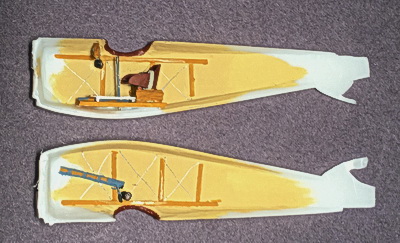
The first step is building up the sparse interior, a common lacking in Blue Max kits.  The floorboard is plastic card stock to which was added foot skids, rudder bar, and control column.  The seat was taken from my stash of seats to which were added PE seat belts.  The instrument panel is scratch-built with Eduard WW1 instruments.  The left side angular support is scratch-built with the kit's throttle added and another Eduard instrument adjacent to it. 


CONSTRUCTION PHOTO No. 2
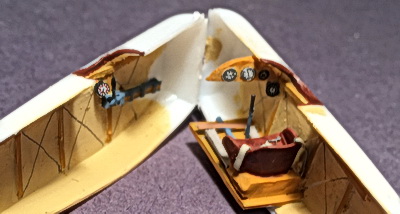
Side views of cockpit interior before gluing fuselage halves together.  Interior wood framework painted in Vallejo 824 Orange Ochre.  Interior metal components painted in Andrea NaC-24 Union Blue.


CONSTRUCTION PHOTO No. 3
Fuselage halvces are glued together.  They were held in place by rubber bands.  When dry, excess glue and plastic was sanded off.  Next, a coat of MMD White Putty was added over fuselage seams and sanded down.  The horizontal tail surface was drilled out to take Eduard control horns later.


CONSTRUCTION PHOTO No. 4
As usual with my models, I have reconstructed the landing gear using brass rod and tube, in this case Albion tube 1.3mm OD.  The landing gear axle was (not shown) was fashioned from larger scale brass tube 1.9mm OD.  The brass rod insert has a diameter that will just fit into the wheel recess.  Barely visible at the tail are small diameter brass rod tail support replacing the kit's parts.


CONSTRUCTION PHOTO No. 5
The completed landing gear sub-assembly is shown with the model's wheels loosely attached.  The brass will be primed and painted.  Later, rigging will be applied.  This specific Nieuport 11 was imported from France and has the French 1916-1917 four-color camouflage applied to the wheel covers.


CONSTRUCTION PHOTO No. 6
Components completed.  The top wing comes in two halves and had to have two brass pins installed, then glued together,  filled with putty, and sanded.  The kit's rotary engine was scrapped and a metal version substituted.  The other parts shown above were cleaned, primed, and painted. 


CONSTRUCTION PHOTO No. 7
The top wing is glued to the cabin struts which were made from brass tube and rod replacing the kit's plastic parts.  I did not proceed with the wing struts because I have a choice between the kit's white metal struts or an alternate set of plastic wing struts from an Eduard Nieuport 11 kit.


CONSTRUCTION PHOTO No. 8
I have decided to paint this Russian Nieuport 11 in the French 1916 4-color scheme of dark brown, red brown, dark green, and light green using my own pre-mixed Vallejo acrylic paints.  The pattern is random.  The French and Germans began applying camouflage to aircraft at about the same time.  As a result, friendly aircraft were sometimes attacked as enemy aircraft because the camouflage schemes were similar.  France adopted a 4-color scheme.  Germany adopted a 3-color scheme.


CONSTRUCTION PHOTO No. 9
This view shows the beginnings of the top wing Lewis machine gun mounting which is built from brass rod, the kit's parts were discarded except for the vertical resin mount.  Wing aileron rods of small diameter brass are shown near the rear cabane struts.  The cabane struts, landing gear struts, axle, and cowling are painted in Vallejo 864 Natural Steel.


CONSTRUCTION PHOTO No. 10
This left-side view is the first of six photos of the finished model.  In each, I will address construction additions not covered in the previous photos up to photo #9.  Kit wing struts were used and the blue paint mimics the taped bands used to hold both halves of the strut's wood covering.  Note that the cabane struts and cowling are painted in bare metal using Vallejo 864 Natural Steel.


CONSTRUCTION PHOTO No. 11
This right-side view shows the application of the upper and lower wing underside Russian cockade decals from Blue Rider's BR507 1:48 scale decal sheet which I purchased on line.  


CONSTRUCTION PHOTO No. 12
Photo 12 attempts to show the hand-painted rudder colors and the application of hand-made Laser-printed rudder decals in black (barely visible).  The horizontal tail edging is done in Andrea NAC-24 Union Blue.  Note that I had yet completed the application of the blue 'tape' to the wing edges. 


CONSTRUCTION PHOTO No. 13
The tail control rigging is .005 MFT attached to Eduard control horns which are painted French light blue.  The rudder markings are barely visible.  The rudder stripes were hand-painted using Andrea XNAC-01 White, Vallejo 947 Dark Vermillion, and 899 Dark Prussian Blue.  The tailskid is a partially flattened brass rod. 


CONSTRUCTION PHOTO No. 14
The kit's Lewis Gun and post-mounting were used but the other parts are hand-made from brass rod.  Inter-wing rigging is .006 MFT.  I'm nearly out of .005 MFT and could not find a replacement spool in charcoal.  I had to purchase a large industrial machine spool in .006.


CONSTRUCTION PHOTO No.15
This last image shows more of the top wing's Lewis Gun.  Note that the landing gear struts are bare metal but the air foil covered axle is Humbrol 103 Matte Cream as is the whole underside of the model.  Following this panel is a portrait photo of Gilsher taken from The Imperial Russian Air Service, Famous Pilots and Aircraft of WW1.


-------------------------------------------  c'est finis ---------------------------------------

Bibliography:

Bruce, J. M.  Nieuport Fighters, Volume 2, Windsock Datafile Special.  Berkhamsted, Herts: Albatros Productions, 1993.

Durkota, Alan, Thomas Darcey, Victor Kulikov.  The Imperial Russian Air Service, Famous Pilots and Aircraft of WW1.  Mountain View, CA: Flying Machines Press, 1995.

Franks, Norman, Russell Guest, and Gregory Alegi.  Above the War Fronts. London, UK: Grub Street, 1997

Lamberton, W. M., Compiler, and E. F. Cheesman, Editor.  Fighter Aircraft of the 1914-1918 War.   Los Angeles, CA: Aero Publishers, 1962.


GO TO?

FRENCH WW1 AIRCRAFT INDEX

BACK TO WW1 AIRCRAFT INDEX

NAVIGATE TO OTHER PAGES HISTORICAL MINIATURES HOME
COPYRIGHT TOP OF PAGE

13 June 2025