|
|
HISTORICAL MINIATURES BY GEORGE GRASSE |
|
|
|
HISTORICAL MINIATURES BY GEORGE GRASSE |
|
|
NIEUPORT 28 N.6164, 1/Lt Douglas Campbell, 94th Aero Squadron, USAS, 1918 |
by George Grasse

RODEN 1:48 SCALE PLASTIC INJECTION MOLDED KIT OF THE NIEUPORT 28 C.1
|
RODEN NIEUPORT 28 BOX ART
|
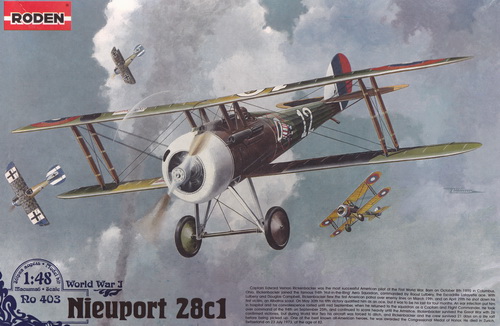 |
|
NIEUPORT 28 3-VIEW DRAWING
|
.jpg) |
| This 3-view drawing is credited to J. D. Carrick or F. Yeoman and appeared in Fighter Aircraft of the 1914-1918 War compiled by W. M. Lamberton and published by Harleyford Publications Limited. The Nieuport 28 was not accepted by the French Aeronautique Militaire in any role except training but was widely available for the U. S. Air Service and began operations with it in April 1918. |
|
THE
MODEL TO BE BUILT
|
%20x700.jpg) |
| Nieuport 28 N.6164, 1/Lt. Douglas Campbell, 94th Aero Squadron, 1918 (image credit: Harry Dempsey from Nieuport Aces of World War I by Norman Franks, Osprey Publishing. Lt. Campbell was a 6-victory ace of the 94th. |
.jpg)
|
CONSTRUCTION PHOTO No. 1
|
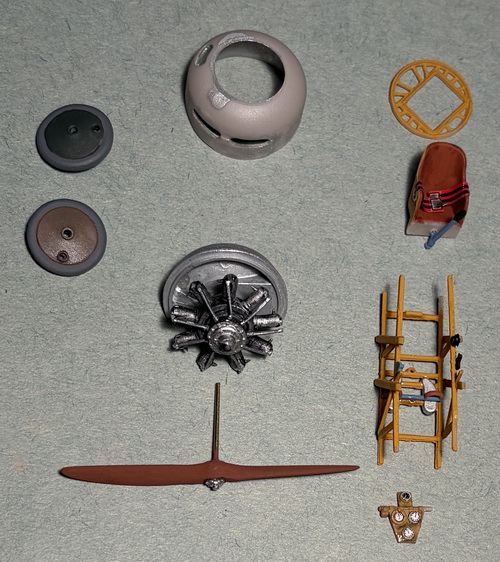 |
| The beginning of the project: on the far left, wheels with alternating camouflage colors of chestnut brown and dark green; in the middle at top is the assembled cowling, and below it the built-up rotary engine and propeller; the column of parts on the right begin with the end cockpit former, then the seat, then the cockpit framework, and lastly the instrument panel with the addition of Eduard gauges. |
|
CONSTRUCTION PHOTO No.
2
|
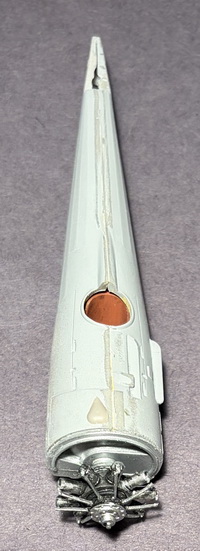 |
| The fuselage halves were glued together and allowed to dry. The cockpit sub-assembly was inserted through the open end, positioned, and glued in place. The rotary engine sub-assembly was next glued to the fuselage front as shown above. |
|
CONSTRUCTION PHOTO No.
3
|
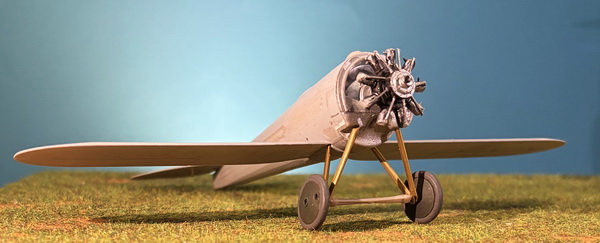 |
| The engine was pre-assembled according to instructions and glued to the front firewall. The cowling went through several dry fittings and then glued to the fuselage front. Next, the lower wing was glued in place followed by the horizontal tail. Lastly for this step, the landing gear struts were built from brass tube and rod. I decided to use the kit's landing gear axle/spreader but had to use fine piano wire as substitutes for the axle which was cut off. The corresponding hole in the wheels was too large but I fashioned brass tube bushings to match the piano wire axles. |
|
CONSTRUCTION PHOTO No.
4
|
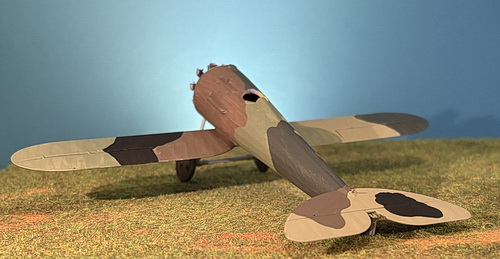 |
| This photo shows the application of the first coat of the 5-color 1917-1918 camouflage scheme. All colors are my own pre-mixed batch of dark green, light green, beige, and chestnut brown. Black is by Vallejo. |
|
CONSTRUCTION PHOTOS No.
5 a,b,c
|
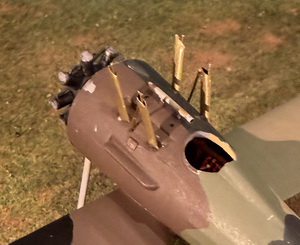 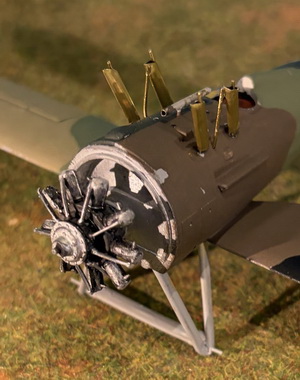 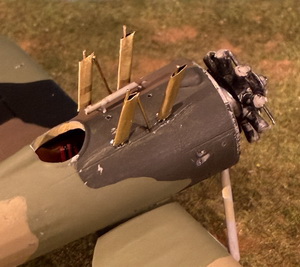 |
| These photos illustrate the central fuselage strut arrangement, the telescopic gun sight, and rotary engine detail. In the left photo, the telescopic gunsight was made from brass tube into which were drilled two holes to accept brass rod for height and support. The rear two fuselage struts have a brass rod support. The rotary engine had to have the tops of its cylinders sanded down to fit into the cowling. Each strut is flattened 1.8mm brass tube with brass rod serving as wing locator pins. Cross rigging between the front struts and again for the rear struts will be down after the top wing is attached. |
|
CONSTRUCTION PHOTO No.
6
|
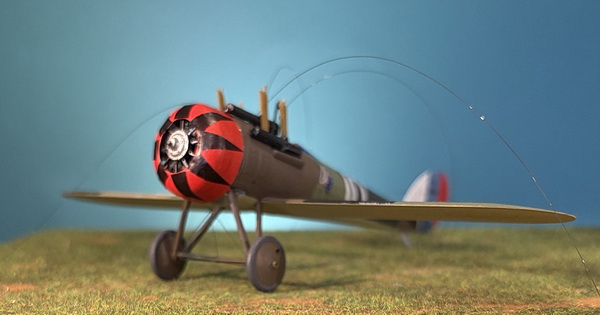 |
| The cowling is painted in Vallejo 909 Vermillion. The black pointed decals are individual pieces taken from an older Blue Max kit representing Campbell's N.6164. The fuselage rigging are cross rigging from the fuselage to the top of each strut with the remaining longer piece used to complete the rigging to the bottom of each corresponding wing strut. Vickers machine guns are in place. |
|
CONSTRUCTION PHOTO No.
7
|
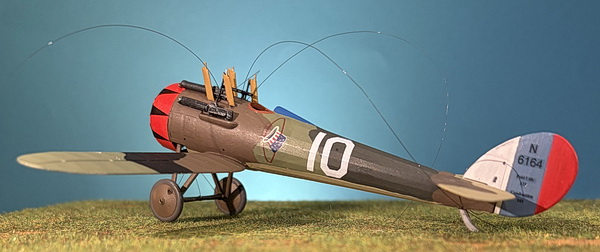 |
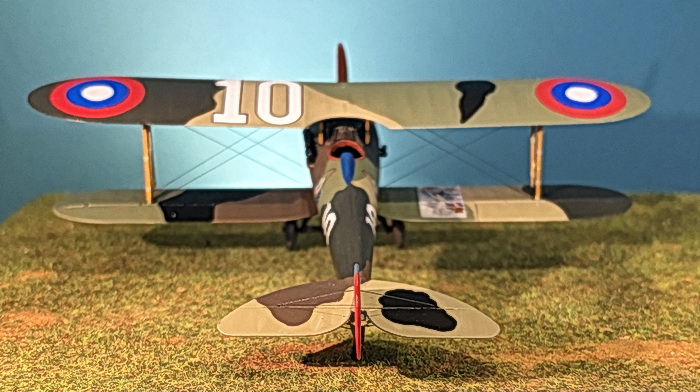
| The forward fuselage details described in the previous photo are clearly shown. The headrest is painted Vallejo 963 Medium Blue. Fuselage decals for the unit's emblom "hat-in-the-ring" and Campbell's white '10' are well shown. The digit "1" needs to have white detal added to the top and bottom. All of the tail inscriptions were printed on my laser printer and based on details from Theodore Hamady's Nieuport 28 - America's First Fighter, pages 252-254. The rudder was primed and painted white. Then the red and blue stripes were hand-painted. The tailskid is made from brass tube with a brass rod stiffener and pounded somewhat flat. Also of note is the landing gear rigging. |
|
CONSTRUCTION PHOTO No.
8
|
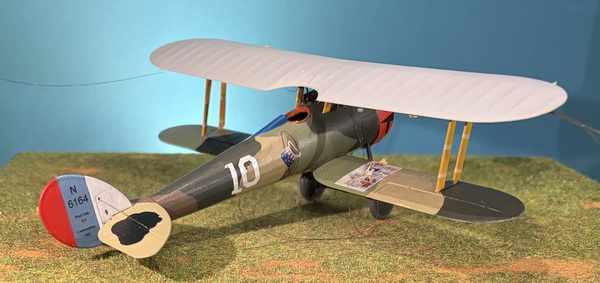 |
| The top wing was pre-drilled on the underside for strut and rigging holes. Rigging is .oo6 MFT and all of these were glued to their underside holes and taped away from the fuselage struts. The top wing wasw attached to the fuselage struts and took several dry-runs. The outer wing struts were added, primed, and painted with Vallejo 856 Ochre Brown. When dry, the binding tapes were painted using my mix of off white. Note that the white '10' decals were taken from Aeromasters 1/48 scale White U.S. 45 Degree ID Numbers and Letters decal sheet. I added extra 'ticks' the numeral '1'. Compare this photo with the previous one. |
|
CONSTRUCTION PHOTO No.
9
|
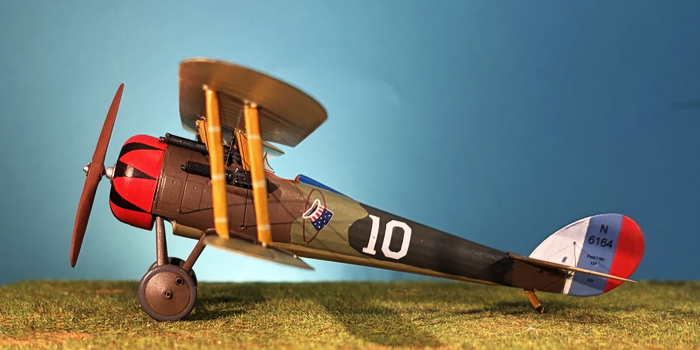 |
| All fuselage and wing rigging are completed. |
|
CONSTRUCTION PHOTO No.
10
|
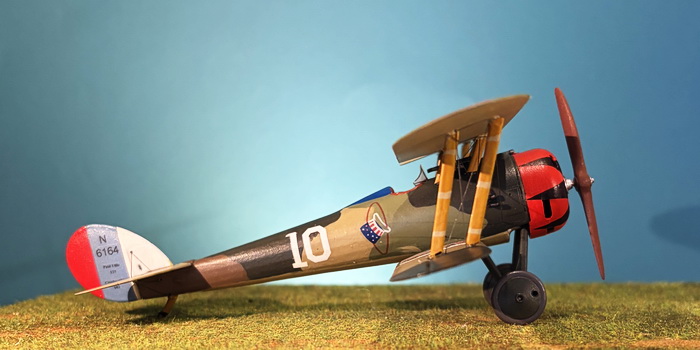 |
| The propeller and front of the rotary engine were drilled out to take a short brass rod. |
|
CONSTRUCTION PHOTO No.
11
|
 |
|
CONSTRUCTION PHOTO No.
12
|
 |
|
CONSTRUCTION PHOTO No.
13
|
 |
|
CONSTRUCTION PHOTO No.
14
|
 |

Modeling References and Bibliography:
Archer, Robert D. The Official Monogram US Army Air Service & Air Corps Aircraft Color Guide, Volume 1, 1908-1941. Sturbridge, Massachusetts: Monogram Aviation Publications, 1995.
Casari, Robert B. American Military Aircraft 1908-1919. Aeronaut Books, 2014.
Guttman, Jon. Nieuport 28, Windsock Datafile 36. Berkhamsted. Hertfordshire, UK, 1992.
Hamady, Theodore. The Nieuport 28 - America's First Fighter. Atglen, PA: Schiffer Military History, 2008.
Maurer, Maurer, editor. The U.S. Air Service in World War I, four volumes. U. S. Government Printing Office, 1979.
Lamberton, W. M., Compiler, and E. F. Cheesman, Editor. Fighter Aircraft of the 1914-1918 War. Los Angeles, CA: Aero Publishers, 1962.
Toelle, Alan D. "French 1918 Camouflage Colors - Typical Palette", 2001.
U. S. Air Service 95th Aero Squadron: https://en.wikipedia.org/wiki/95th_Aero_Squadron.
Wilberg, James. Sumner Sewell: Maine's First World War Fighter Ace. Aeronaut Books, 2019.
GO TO?
19 August 2026
