|
|
HISTORICAL MINIATURES BY GEORGE GRASSE |
|
|
|
HISTORICAL MINIATURES BY GEORGE GRASSE |
|
|
HANRIOT HD.1, HD.515, 76a Squadriglia, Flavio Baracchini, Royal Italian Air Service 1918 |
by George Grasse
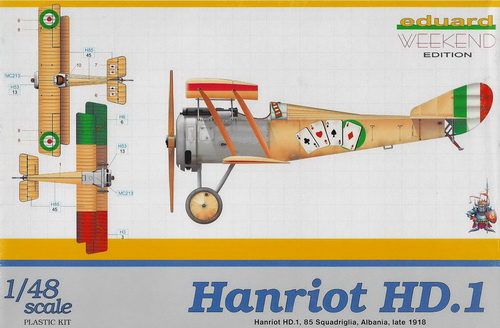
EDUARD 1:48 SCALE INJECTION KIT EU8402 of the HANRIOT HD.1 in ITALIAN SERVICE
|
EDUARD EU8402 BOX ART
|
 |
|
HANDRIOT HD.1 3-VIEW DRAWING
|
/Hanriot%20HD.1%203-View%20x500.jpg) |
| This 3-view drawing is reproduced here from the Harleyford publication Fighter Aircraft of World War 1. The Hanriot HD.1 was a French-designed fighter aircraft rejected by the French Aeronautique Militaire in favor of the mass production of Spad fighters. Hanriot found ready markets in Belgium (80) and Italy (360). As deliveries from France continued, a license agreement to Maachi in Italy to build the Hanriot eventually led to the delivery of 991 additional Italian-built Hanriot HD.1 fighter. |
|
THE
MODEL TO BE BUILT
|
%20x700.jpg) |
| The model to be built is Hanriot HD.1 aircraft No.515 flown by Ten. Flavio Torello Baracchini of the 76a Squadriglia. He survived the war with 21 victories although many more could not be officially recognized. Hanriot HD.1 No.515 was French-built. This image was produced by Bob Pearson found in volume 3, page 55, of Italian Aviation Units by Roberto Gentilla. Consult the bibliography below. |
%20photo.jpg) |
| The man, the plane, and the cards. Note that two aces are on each horizontal stabilizer, probably spade and diamond on the left, club and heart on the right. |
|
CONSTRUCTION PHOTO No. 1 |
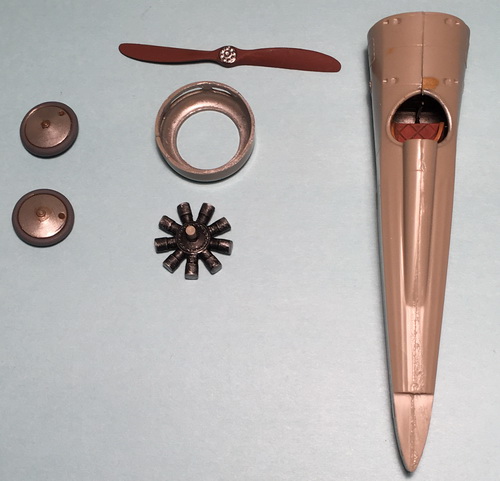 |
| Before I realized it, the fuselage was closed up and I did not have a photo of the cockpit interior. I had to settle for a partial view of the seat. Other components that I managed to pre-paint are the wheels, the propeller, the inside of the cowling, and the rotary engine. I've built two other Hanriot HD.1s, one in the Swiss Air Force section and one in the WW1 Belgian section. |
|
CONSTRUCTION PHOTO No. 2 |
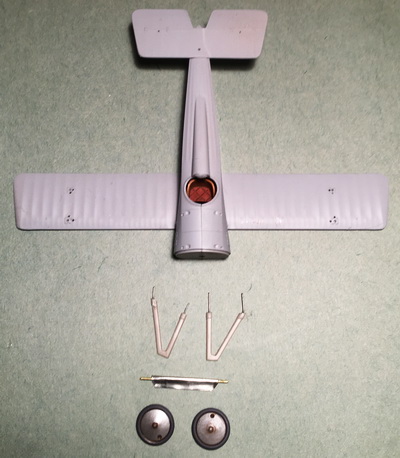 |
| The bottom wing was pre-drilled for rigging wires and then glued to the fuselage. The landing gear was addressed next. In this case, I decided to use the kit's plastic landing gear struts and carefully drilled tholes to received piano wire pins. Next, I built an axle unit with brass rod and wine bottle lead foil (note that I have to trim it). The wheels have already been painted. |
|
CONSTRUCTION PHOTO No.3 |
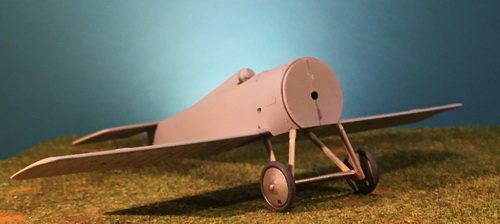 |
| The completed landing gear is attached. |
|
CONSTRUCTION PHOTO No.4 |
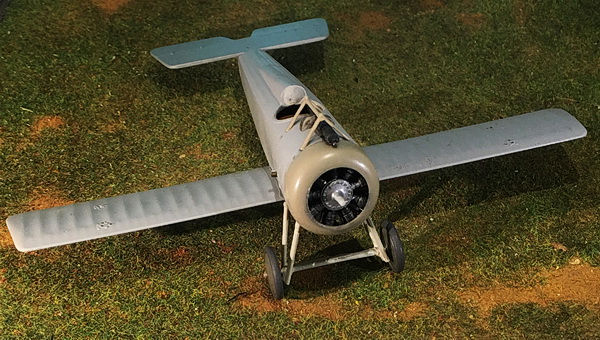 |
| The pre-assembled and painted rotary engine was glued to the firewall with the cowling dry-fitted to ensure engine alignment. The inverted cabane struts was glued in place followed by the Vickers machine gun, the belt-feed chute, and the empty cartridge case chute. |
|
CONSTRUCTION PHOTO No.5 |
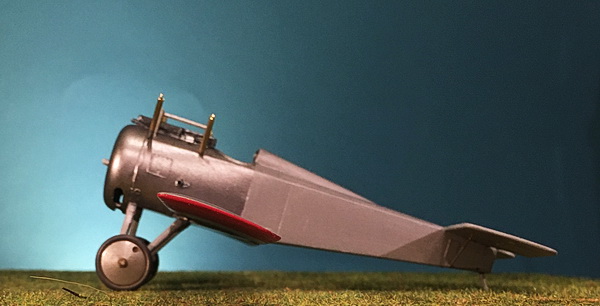 |
| It's time to consider how the Hanriot is to be finished. Since this is a French-built Hanriot HD.1, the likely finish in "enduit metallise" or aluminum-pigmented dope. Fine flakes of aluminum ground to a powder were added to dope with the expectation that the reflective nature of the aluminum would ward off the effect of the sun's rays. It was effective. I used Vallejo 77.716 Semi Matt Aluminum for the fabric surfaces, namely the flying surfaces and the fuselage up to the aluminum metal paneling. For the paneling, I used Vallejo 864 Natural Steel as shown in the photo above. However, adjutsment is required. The Semi Matt Aluminum is not reflective enough and the Natural Steel is too dark. |
|
CONSTRUCTION PHOTO No.6 |
 |
|
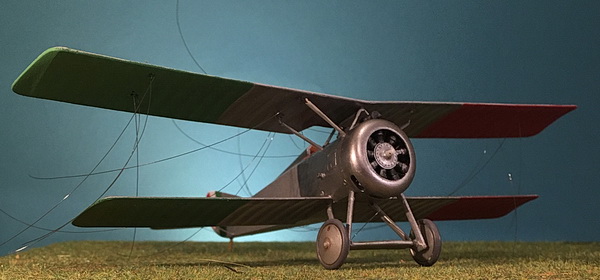
Before setting the top wing in place: 1) the undersides of
both wings were painted in the Italian colors inboard from
the wing tips; 2) green is Vallejo 891 Intermdeiate Green;
3) red is Vallejo 957 Flat Red. All of the wing .006 MFT rigging was installed into pre-drilled holes on the underside of the top wing. The top wing was glued only to the center inverted "V" struts. Next will be the attachment of the main fuselage struts already in place glued to the fuselage. Landing gear rigging was also done at this time. |
|
CONSTRUCTION PHOTO No.7 |
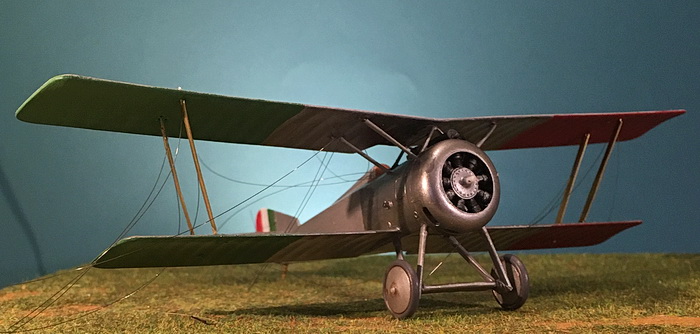 |
| All struts are in place ready for the attachment of rigging. |
|
CONSTRUCTION PHOTO No.8 |
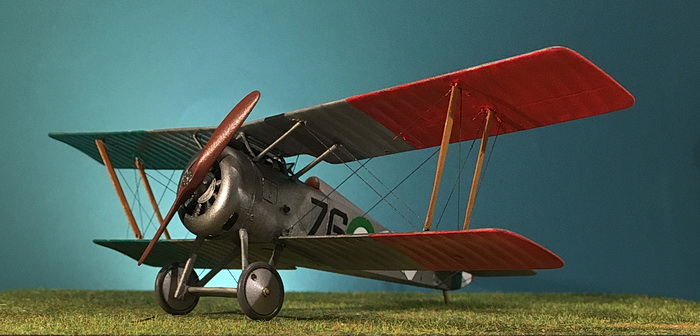 |
| All rigging is completed including wings, fuselage, landing gear, ailerons, and rudder. All struts are in place ready for the attachment of rigging. The underside of the port wings are now painted in Vallejo 817 Scarlet. |
|
CONSTRUCTION PHOTO No.9 |
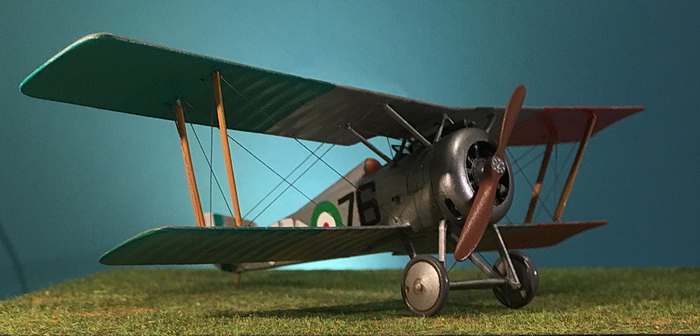 |
| The underside of the starboard wings are now painted in Vallejo 838Emerald Green. |
|
CONSTRUCTION PHOTO No.10 |
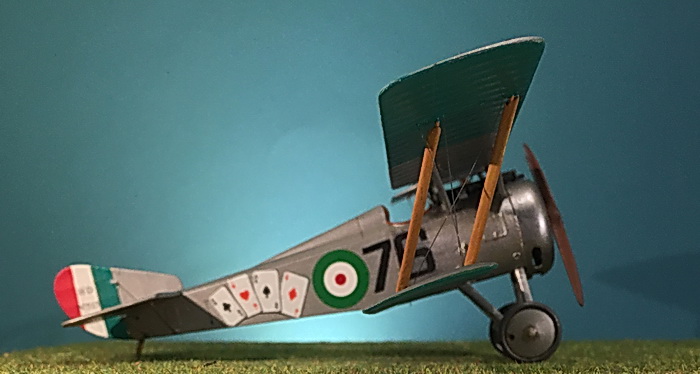 |
| Fuselage decals were taken from three sources. The playing cards came from the current kit Eduard 8402 and had the roundel cut away. The Italian roundel came from another Eduard decal sheet from an earlier Hanriot HD.1 build. The numerals were made by copying '7' and '6' from another Eduard kit, re-sizing them, and printing them on my laser printer. |
|
CONSTRUCTION PHOTO No.11 |
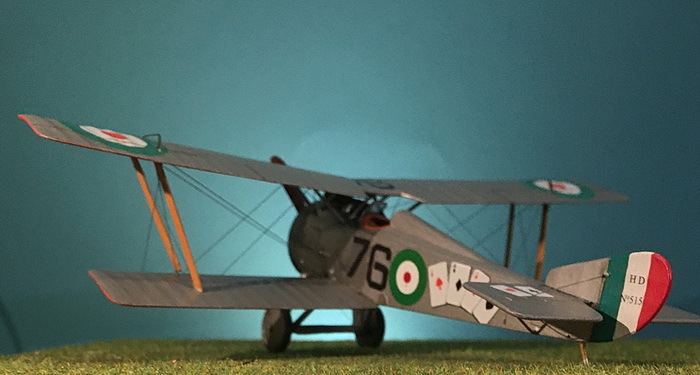 |
| The rudder decals were made on my laser printer by finding an appropriate font and experimenting with size. The playing cards on the horizontal stabilier are taken from the same decal sheet as the fuselage playing cards, namely this specific kit. |
|
CONSTRUCTION PHOTO No.12 |
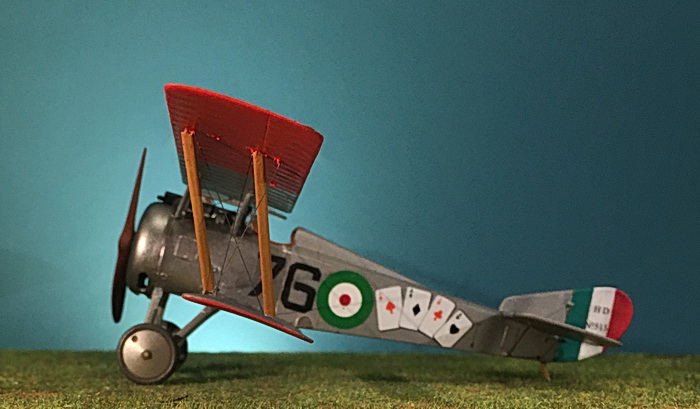 |
| The tail skid was made from scrap brass tubing and rod. The horizontal stabilizer support rods are brass. All rigging is .006 MFT. |
|
CONSTRUCTION PHOTO No.13 |
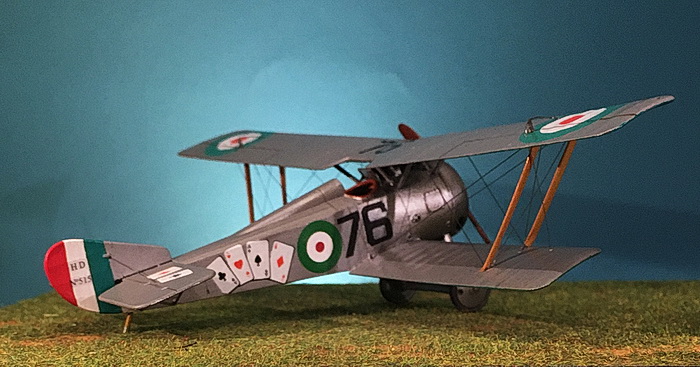 |
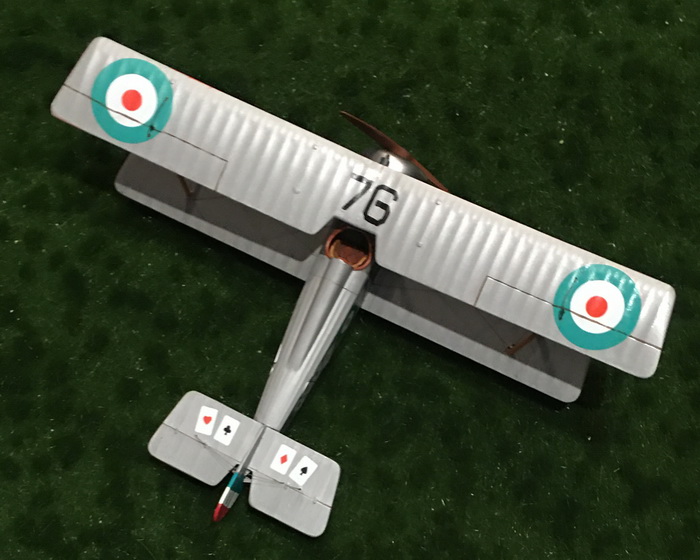
| A good view of the placement of decals including the center of the top wing. |
|
CONSTRUCTION PHOTO No.14 |
 |
------------------------------------------- C'EST FINIS ---------------------------------------
Bibliography:
Alegi, Gregory. Hanriot HD.1/HD.2, Windsock Datafile No.92. Berkhamsted, Herts: Albatros Productions, 2002.
Davilla, James J. Dr. and Arthur M. Soltan. French Aircraft of the First World War. Boulder, CO: Flying Machines Press, 2002.
Franks, Norman, Russell Guest, and Gregory Alegi. Above the War Fronts. London, UK: Grub Street, 1997
Gentilli, Roberto. Italian Aviation Units in the First World War, volume 3. Aeronaut Books, 2024.
Lamberton, W. M., Compiler, and E. F. Cheesman, Editor. Fighter Aircraft of the 1914-1918 War. Los Angeles, CA: Aero Publishers, 1962.
GO TO?
30 December 2025
